Journées NuTS 2023
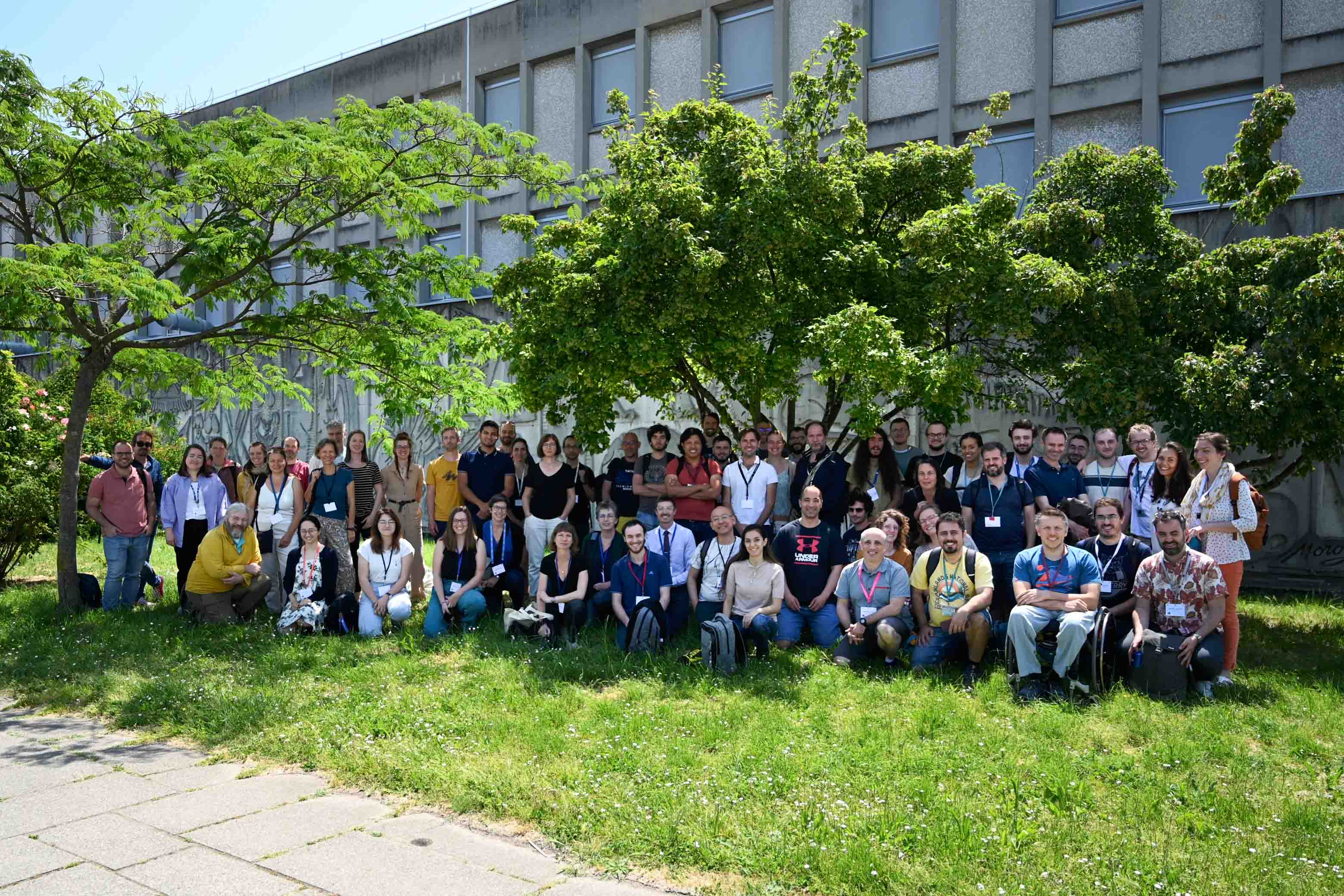
Présentation
Les ressources de calcul et l'apprentissage machine : deux jours de présentations, puis deux jours de travaux pratiques (Jupyter, Python) sur les GPU A100 du mésocentre GLiCID, et une session posters.
Lieu
Bâtiment Darwin, 3-9 rue Raphaël Dubois, 69100 Villeurbanne (campus de la Doua).
Présentations
| Intervenant | Affiliation | Titre | Support |
|---|---|---|---|
| Yann Capdeville | LPG, CNRS, NuTS | Introduction | |
| Yann Capdeville | LPG, CNRS | Hardware and Resources for scientific HPC | |
| Hatim Bourfoune | IDRIS | Jean Zay | |
| Aurélien Garivier | ENS Lyon | Understanding the Efficiency of Machine Learning: Progress and Challenges | |
| Maëlis Arnould | LGLTPE | Diamond open access journals | |
| Marielle Malfante | CEA | AI for monitoring: focus on reliability and anomaly detection | |
| David Michéa | EOST | Automatic machine learning classification of ground displacement data cubes: application to large InSAR and optical datasets | |
| Sophie Giffard | ISTerre | Examples and best practices of using machine learning in geosciences, especially neural convolution networks | |
| Damia Benet | Earth Observatory of Singapore | Machine learning for volcanic ash studies | |
| Thomas Bodin | LGLTPE | Using Generative Networks for Inverse problems | |
| Nestor Cerpa | Géosciences Montpellier | Using deep learning to predict the evolution of mechanical anisotropy in the Earth's mantle due to texture development | |
| Nathanael Schaeffer | ISTerre | Neural networks and inverse problem: application to Earth's core flow estimation | |
| Léonard Seydoux | IPGP | AI-based seismic and geodetic data fusion for understanding geophysical phenomena | |
| Gautier Laurent | ISTO | A Geocognitive Approach to Machine Interpretation of Geological Structures | |
| Clément Hibert | ITES | Contribution of machine learning to environmental seismology | |
| Quentin Blétery | Géoazur | Can AI anticipate earthquakes? | - |
Posters
- Gautier Laurent (ISTO), Geocognitive knowledge-based geological modelling: proof of concept
- Céline Hourcade (LPG), Detection and discrimination of low magnitude seismic events: Application to the Armoricain Massif
- Buchanan Kerswell (Géosciences Montpellier), Computing Rates and Distributions of Rock Recovery in Subduction Zones
- Théo Santos (LGLTPE, CRAL), Generative neural networks for downscaling the upper mantle
- Amandine Fratani (RING, GeoRessources), Can neural networks learn how to associate fault data? First results
- Mathieu Nougaret (IPGP), The use of machine learning algorithms to help in the prediction of eruption at the Piton de la Fournaise volcano
- Said Sadeg (GeoRessources), Analyse des données de la μ-XRF
- Nicolas Gilardi (BRGM), Geoscientific benchmarks for AI methods
- Yuqing Xie (Géoazur), Deep Learning-based array processing with RNN and MLP
Formations et tutoriels
| Intervenant | Affiliation | Titre | Support |
|---|---|---|---|
| Léonard Seydoux | IPGP | First steps with data preparation | - |
| Léonard Seydoux | IPGP | Machine learning approaches | - |
| Léonard Seydoux | IPGP | Deep Learning with PyTorch | - |
| Léonard Seydoux | IPGP | Deeper dive in artificial intelligence | - |